



Taste doesn't scale on its own
- Source
- LinkedIn Note
- Date
- Link
Taste is having a moment in tech right now, which makes sense. As more people build with the same models and the same tools, more of the differentiation comes down to judgment.
And taste is obviously more than aesthetics. Above all, it's what to build, who to build for, and what kind of product those choices imply. Then there's another layer of taste in how you design the product to actually serve that strategy and audience: how dense or spacious it feels, how playful or serious, what kinds of interactions, visual language, and copy make sense for this product rather than another one.
The challenge in an AI-native workflow is that this second layer of taste doesn't automatically scale with you.
A lot of founders are running into this pretty quickly: decision consistency becomes a bottleneck. Once you make a call on visual language, UX patterns, interaction style, copy, and overall feel, how do you get agents to keep making decisions through that same lens without constantly fixing outputs?
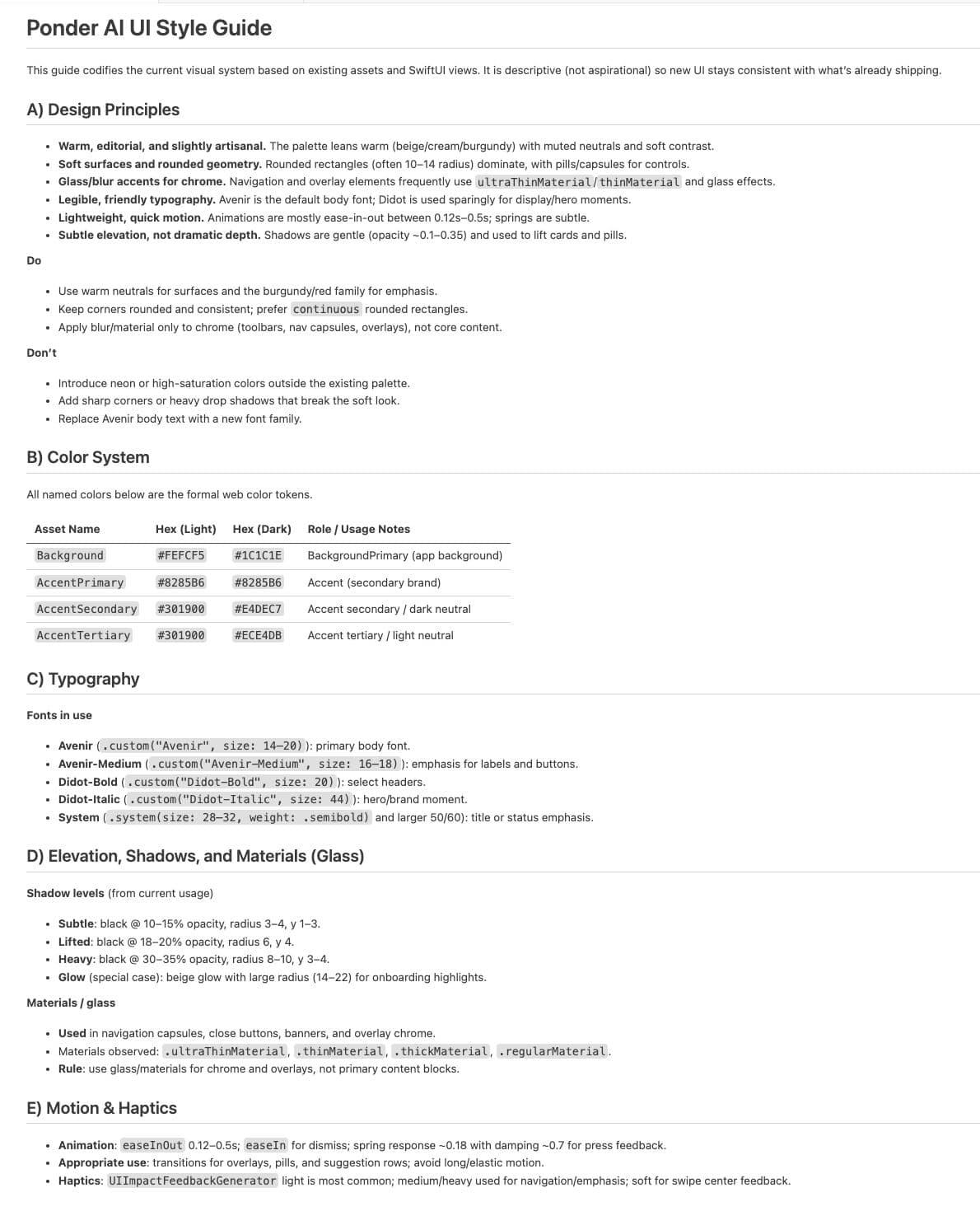
Style guides are the lightweight tool for this. They won't capture the entirety of taste, of course, but they can help operationalize it.
In practice, your style guide can start simple. Find products in the same category as yours that you think are effective, even if you can't articulate why. Then use ChatGPT or Claude to help analyze the patterns across them. Look at things like color palette, typography, spacing, image styles, animations, and so on. The point isn't to imitate another product; it's to get more precise about the choices you're trying to make.
Then ask it to write you a style guide and save it as a STYLEGUIDE.md in your project. Use it for an initial redesign pass without changing functionality, then make sure your AGENTS.md references it and keeps it updated as the product evolves.
Design teams have always relied on systems to keep taste coherent as they scale. AI builders should think the same way. The model can produce polished work, but without a system, your judgment doesn't reliably persist from one output to the next. Taste only becomes a durable advantage once it's legible enough to scale with you.